Arthur Brownlee
The North WaterArthur Brownlee is the long-serving captain of the Volunteer and a seasoned whaling man confronting the contraction of the trade he has spent much of his life pursuing. His authority rests on experience, commercial calculation, and a hard-eyed assessment of people. Yet the voyage north tests more than his ability to find whales: its financial arrangements, a sailor’s death, and the dangers of ice place his practical command within a widening conflict between ordinary maritime work and a plan to profit from the ship’s loss.
Identity and Command
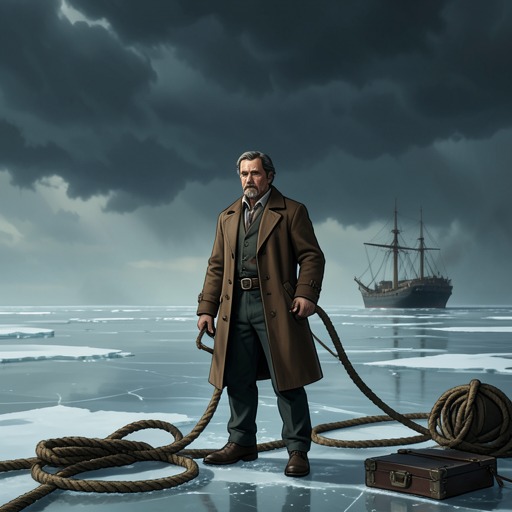
After thirty years pacing a quarterdeck, Brownlee considers himself a fair judge of character. His first response to Patrick Sumner is not simple approval: he notices the surgeon’s awkwardness, limp, and manner, but finds his indifference to pleasing others appealing and decides that he will do. In the captain’s cabin, Brownlee gestures toward his own ankle as he asks about the injury. Sumner explains that he was wounded by a musket ball in Delhi during the siege. The exchange places Brownlee in the role of an observant commander, interested in the history behind a crewman’s physical condition as well as his prospects aboard ship.
Brownlee’s command combines blunt discipline with an interest in performance and value. When the Volunteer leaves Hull, he leans against the wheelhouse as the steam tug carries the ship onward, and speaks impatiently of the men awaiting him in Lerwick. The scene presents a captain accustomed to judging a voyage through its people and prospects rather than romanticizing life at sea. His experience also makes him alert to the divide between what a whaling ship once could earn and what modern equipment and uncertain catches now permit.
The Whaling Trade and Commercial Judgment
Brownlee insists that he remains a whaling man and expects to fill the Volunteer’s hold. Jacob Baxter counters that the industry has changed: earlier voyages could return quickly with valuable whalebone, while present-day success requires expensive steam power, harpoon guns, and luck, and a ship may still come back empty. Brownlee does not concede the point. His confidence is a professional commitment, but it also reveals how closely his identity is bound to a trade whose former returns have become harder to achieve.
At the seal hunt, Brownlee’s calculations translate the work into expected cargo and revenue. After the boats return, he counts the skins and estimates that four hundred could produce nine tons of oil, with each ton worth about forty pounds if the market holds. The catch is a promising beginning, not a reason to stop: other Dutch, Norwegian, Scottish, and English ships are working the same pack, which is already breaking apart. Brownlee surveys the floe edge from the crow’s nest and chooses a likely location for the next hunt. His leadership is thus shown through both immediate direction and calculation of what the crew’s labor may yield.
He applies the same commercial attention to the first whale. After the carcass has been brought alongside, Brownlee measures it with a knotted line and estimates ten tons of oil and at least half a ton of whalebone, together worth close to nine hundred pounds at market if prices remain firm. He tells Sumner that they may yet be rich. The remark links the spectacle of the hunt to the ledger that governs the voyage: animal, labor, cargo, and market price enter the same calculation. Brownlee also rewards the crew after the flensing with an extra ration of rum, acknowledging the collective work that has turned the whale into saleable material.
Baxter’s Scheme and the Volunteer’s Future
Brownlee’s commercial outlook becomes more precarious in his dealings with Baxter. Baxter presents papers and emphasizes that twelve thousand pounds divided three ways would exceed what Brownlee could reasonably expect to earn from whaling. Brownlee nods, but his response is not passive: he insists that Campbell must be present when needed and threatens to turn the ship back if Campbell is not there. The exchange places Brownlee in a consequential position within an arrangement whose profit depends on more than a successful hunt.
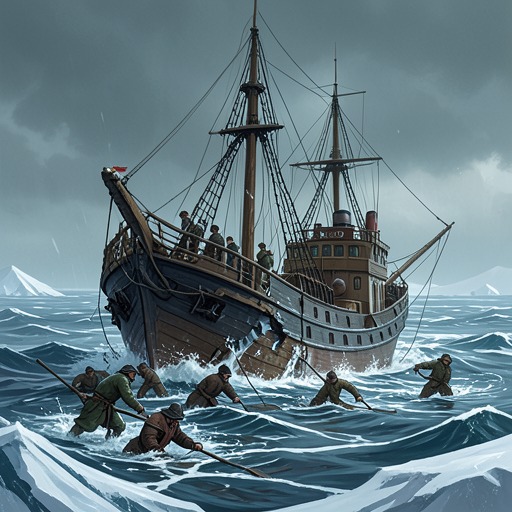
Baxter describes money as something that follows its own course, regardless of what the men involved might prefer. Brownlee answers by pointing to the practical condition the plan requires: enough ice must be present. Later, Campbell explains that the whales are secondary to arranging the Volunteer’s sinking so that it appears convincing to the underwriters. He warns that the opportunity may not last and that delay could leave his own ship trapped. The voyage is therefore divided between visible whaling work and the concealed timing and appearance of an insured loss. Brownlee’s insistence on Campbell’s presence, his attention to the ice, and his place in these conversations show him navigating that double purpose, though the available scenes do not establish every detail of what he knows or intends.
During the passage from Jan Mayen Island toward Cape Farewell, the crew’s spirits rise after successful sealing, and Brownlee senses renewed optimism. Campbell is waiting aboard the Hastings beyond Disko Island, but the ships are not to meet or communicate until the moment is right, since underwriters are alert to possible conspiracy and the Volunteer is unusually heavily insured. Brownlee regards this as his final voyage. The prospect of an ending he would not have chosen is set against his continued insistence on looking ahead and completing what comes next.
Crisis, Responsibility, and Narrative Role
When Joseph Hannah is found dead, Brownlee identifies the death as strangulation and calls it an outrage. He then sets out a methodical inquiry: after the making off is finished, he will speak to the thirty-four crewmen who remain once he and Sumner and the two cabin boys are excluded, individually if necessary. He expects that a crime of this kind would have left signs, rumors, or witnesses in the forecastle, which he characterizes as a center of gossip. The response shows a captain attempting to turn collective shock into a structured search for information, even as Sumner questions whether the perpetrator may be mentally ill.
Brownlee’s importance lies in the friction between these forms of responsibility. He is a working captain who directs hunts, assesses the price of a catch, and proposes an investigation into a death aboard his ship; he is also drawn into conversations where the Volunteer’s insured value and the appearance of its loss outweigh the whales. Through him, the novel connects the physical labor of whaling to the commercial arrangements that govern it. His confidence in filling the hold persists even as the voyage’s actual stakes shift from hunting to the fate of the ship itself.